Before any nuts can be processed for sale, the processing facility needs to meet the Canadian Food Inspection Agency safety standards, or in the United States the FDA standards. This can be reviewed on their websites but basically they are common sense standards expected in any clean restaurant or home kitchen.
The nuts need to be washed, sanitized, dried and then packaged or stored in a clean, rodent and pest free area if they are not cracked right away.
Before cracking, make sure the nuts are dry enough. They should be about 8% moisture level. If the moisture level is too high, then the nuts will mold in storage. If they have been properly dried in a dryer and have been stored in a dry location, then the nuts should be ready for cracking.
It is important to size the nuts before cracking, especially for hazelnuts, otherwise kernels will be split on larger nuts and smaller nuts will go right through without cracking. Once the nuts are sized through screens, all of one size can be cracked at once. Roller crackers adapted from grain mills may be the best way for the small processor to handle the cracking process. This type of cracker works well for hazelnuts, Persian walnuts and black walnuts.
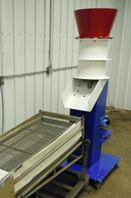
New products that can be used to crack black walnuts are the “Patriot 1” or “Patriot 2” black walnut crackers. They have a rotating cone inside of a larger cone. The cones are spaced apart enough to not allow the walnuts to drop between the cones without cracking. Sizing the black walnuts may not be necessary with these cone crackers.
This cracker may be useful for cracking other hard shelled nuts like hickory and butternut.
A vibrating sorting table can be added to sort the pieces into 3 grades. Since the cone gap in the Patriot crackers are not adjustable, any secondary cracking required can be accomplished in another cracker to remove bound meat pieces.
Further refinements will be needed to crack heartnuts. Heartnuts crack best when the edges are struck. Then they open like a locket, releasing the kernel in one or two pieces. There is demand from specialty restaurants and candy manufacturers for heartnuts, but they want them cracked. Hand cracking is easy but labour intensive. Modern robotics can solve the problem of producing a machine for this job.
Aspirators (similar to dust collectors) are commercially available to remove shell from the heavier nut meats. By pouring the nuts and shell mixture into the stream of upward moving air, the shell being lighter moves upward into the airstream. The heavier nut meats fall straight down into a bin. The amount of separation can be very finely tuned by dampening the amount of lift. This works well with hazelnuts, Persian walnuts and other thin shelled nuts.
An aspirator can also be used to remove debris including leaves, twigs and dust from freshly harvested nuts.
 Separating of shell from nut meats is a tedious and expensive job by hand, even when an aspirator is used. High speed colour sorters have been invented to do this job and the efficiency has improved dramatically over the years. Colour sorters have become an important tool in most nut and other food processing facilities.
A final hand sort is necessary to remove all shell fragments and spoiled nut meats that the colour sorter missed. The meats then can be bagged and sealed with your own attractive label.
It is important to identify all batches of product from harvest through to packaging. This helps to rotate the product to maintain freshness, but is also important for food safety concerns. Several instances of infected nut meats had been identified in US processing facilities. This meant the recall of a specific numbered lot of packages rather than the destruction of all product that was distributed. Proper product control can mean the difference between survival and bankruptcy.
|