



Hazelnuts (Corylus Species) |
|
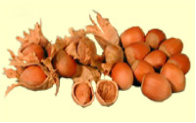 The hazelnut also known as filbert or cob nut, has native species that are widespread over North America, Europe and Asia. Our two native species, the beaked hazel and the American hazel are very hardy, well adapted, small, 1-2 m tall, bushy plants. They produce quantities of small sized, thick shelled nuts. The European hazels, on the other hand, are larger plants, 3-4 m tall, with large thin shelled nuts. Though less hardy, they will grow in the milder regions of North America. They are grown commercially in Oregon northward to the Fraser Valley of British Columbia and more recently in the fruit growing districts of the Niagara Peninsula and South Western Ontario. The hazelnut also known as filbert or cob nut, has native species that are widespread over North America, Europe and Asia. Our two native species, the beaked hazel and the American hazel are very hardy, well adapted, small, 1-2 m tall, bushy plants. They produce quantities of small sized, thick shelled nuts. The European hazels, on the other hand, are larger plants, 3-4 m tall, with large thin shelled nuts. Though less hardy, they will grow in the milder regions of North America. They are grown commercially in Oregon northward to the Fraser Valley of British Columbia and more recently in the fruit growing districts of the Niagara Peninsula and South Western Ontario.
In recent years, eastern filbert blight has found its way to the commercial plantings of the west coast. Oregon State University scientists under the guidance of Dr. Shawn Mehlenbacher have been breeding hazelnuts for resistance with the intention of selecting trees with complete immunity. Some of these introductions including hybrid selections from the east would be suitable for commercial plantings in zone 6b-7 regions of Ontario. Dr. Thomas Molnar from Rutgers University in New Jersey has been working for a number of years to breed new commercial hazelnut selections for Eastern North American conditions with immunity to eastern filbert blight. Selections may be available in a few years. More cold hardy hazel sources have been identified, known as "northern hazels" that can extend the range where commercial hazels can be grown, possibly into zone 4. The hazelnut hybrids tend to bloom very early, often in March, like their European parent. Our native species are later blooming, usually in late March to early April. Though the female flower is very hardy, a cold snap during bloom can affect nut set. The catkins or male bloom are also susceptible to damage caused by cold extended winter conditions or freezing temperatures at bloom. Bloom period can be very short or can extend over 2 weeks or more depending on winter and spring conditions. It is important as a result to have a number of different early and late pollinizers in an orchard to effectively pollinize the orchard and overcome the periodic cold spells that usually occur in March. Pollinizers can be seedlings or several cultivars. Hazelnuts are self-infertile, so at least two different cultivars or seedling plants are needed to produce nuts. 
Hazelnuts are fairly shallow rooted and do well in a range of well-drained soils from sand to clay loams. Field tiles should be used to improve the drainage and though they are somewhat drought tolerant, irrigation should be set up for long dry spells. Better nut quality and sizing of the nut will result. Wind producing machines can be used to reduce the chance of a damaging frost at bloom and extend the commercial range of the hazelnut growing in Ontario. Seedling commercial orchards of European hybrids are not recommended. The blight resistant selections can produce seedlings that have 70% blight resisting offspring. Orchards established with seedlings need to be culled, removing the blight susceptible trees, the trees with the low production, poor filling nuts, trees with small or unsavory quality nuts and the trees with too much bran material adhering to the kernel. New seedlings can be planted to take the place of the culls, but the lost production and time involved are counter-productive. By planting proven cultivars, good trees can be planted from the start. This more expensive alternative will save some work down the road. Layered trees are produced by rooting the sprouts that come up around the base of a hazelnut bush. These sprouts are identical to the tree from which they come and so can be removed from the plant and started as a new tree with the exact characteristics as the parent tree. Clonal hazelnut trees can also be produced from cuttings and by tissue culture. Grafted trees are not recommended.
Hazelnut trees will need to be suckered once or twice during the growing season. Hazels have a bush habit, that is, they produce multiple stems and annually add more sprouts from the root crown. This habit is undesirable to the orchardist as it interferes with the mechanical collection of the nuts. By training the bush to a single trunk right from the time it is planted, a tree form is established. Some growers prefer to allow up to 3 trunks to grow. Whichever training is used, it is necessary to spray any additional annual sucker sprouts to maintain the single or controlled number of trunks. Important Hazelnut Characteristics
Hazelnut Cultivars for Ontario A few of the most blight resistant selections are listed here indicating some of the desirable characteristics. 'Yamhill' --
An Oregon European selection that was designed for the processing trade. It is a medium/small size round nut with flavour characteristics acceptable to Ferrero Rocher. It has good blight and bud mite resistance and is considered a main crop cultivar for zone 6b-8. It ripens about September 10 in Ontario. For more information on this cultivar go to: 'Gamma' -- This Oregon European cultivar was selected as a pollinizer variety for 'Yamhill' and other cultivars in their collection. 'Gamma' is blight resistant and bud mite resistant. At Simcoe Station, it has proven to produce pollen successfully after a cold winter. The nut is medium size, round and ripens about the same time as 'Yamhill'. The nuts are acceptable to Ferrero and can be harvested together with 'Yamhill'. In Ontario, it appears to be a good main crop cultivar too. For more information go to the above website. 'Jefferson' - This is an Oregon European cultivar that was selected to replace 'Barcelona' as a main crop selection for the in-shell market. The nut is large round and is acceptable to Ferrero. It is considered blight resistant, but in Ontario spraying is needed to keep blight under control. It is productive and considered a main crop variety. It ripens about mid-October. For more information go to the above website. 'Gene'™ - (formerly 'Geneva'). This is an immune, European x American hazel hybrid selection. It is very productive and a relatively large spreading tree. It is considered a good pollinizer for all of the selections listed here. Nuts are large and well filled with a clean firm kernel. The nuts ripens mid-October about the same time as Jefferson. The nuts are suitable for the fresh market and need to be harvested separately from the ones going to Ferrero. They should be planted between rows of early ripening cultivars like 'Yamhill'. There are few blanks and it drops clean from the husk. It has low resistance to bud mite and would require sprays for control. 'Linda' and 'Cheryl' are two additional selections that are from the same breeding project that are blight immune and have similar nut and tree characteristics. 'Slate™' - This is a blight immune European x American hybrid selection. It is a very productive medium sized plant, producing few suckers. The nuts are large, well filled with a clean firm kernel. This selection ripens a few days ahead of 'Gene'. There are few blanks and it drops cleanly from the husk. The nuts would be suitable for the in-shell market and can be mixed with the nuts from 'Gene'. It has low resistance to bud mite and would require sprays for control. 'Carmela' - (formerly 208P). This is a seedling selection by Ernie Grimo from nuts obtained from Experimental work done at the Geneva Experimental Farm in NY. It is considered a good pollinizer cultivar for all zone 6 selections. It is a good producer of extra-large oval nuts. The tree is a moderate alternate bearer. The nuts are early October ripening so can be harvested when the early cultivars are out of the orchard. 'Alex' - (formerly 'Grimo 186M'). This is a highly blight resistant, possibly immune, seedling of 'Faroka'. 'Faroka' is a Turkish x European hybrid cross made by Jack Gellatly of West Bank, BC. 'Alex' is upright, large and moderately productive. It is considered a good pollinizer. The nut is oval shaped, moderately large and well-filled with a clean kernel. The nuts ripen the last week of September and drop clean from the husk. It has good resistance to bud mite. 'Matt' - (Formerly 'Grimo 208D'). This is a highly blight resistant, possibly immune, seedling of 'Faroka', a sister tree to 'Alex'. The tree is large, upright and moderately productive with a tendency to alternate bearing. It is introduced as a pollinizer cultivar. The nut is moderately large, oval in shape, well-filled with a clean kernel. The nuts ripen at the end of September and drop clean from the husk. It has good resistance to bud mite. 'Grand Traverse' - This is a 'Faroka' cross made by Cecil Farris, a Michigan backyard breeder. 'Grand Traverse' has high blight resistance, possibility immunity. It is productive and forms a large tree. The nut is clean, moderately large in size and well-filled. The nuts drop clean from the husks about the last week of September. It has good resistance to bud mite. 'Norfolk' - Martin Hodgson from Courtland, Ontario started with 5000 seedling hazelnut trees and after 20 years, this is one of his selections that survived filbert blight and hardiness tests. The tree is hardy to zone 5b and produces a medium sized oval nut. It is considered a pollinizer cultivar for Ontario. The nuts ripen mid-season and are suitable for the fresh market. 'Chelsea' - Martin Hodgson selected this one from his test trials also. The nut and trees are similar to 'Norfolk' above. It is a suitable pollinizer for Ontario zone 5b-8. The nuts can be collected together since they are similar. Northern Cultivars Cultivars for zone 4-5, have been selected to extend the zone where hazelnuts can be grown. These are hybrids of Asian/Quebec, Saskatchewan and Wisconsin sources. These hybrids come from 3 distinctly different backgrounds and offer an opportunity for growers to produce nuts that are larger and more productive than wild sources in their regions. The Asian/Quebec and Saskatchewan trees ripen the nuts by the end of August, two weeks before the earliest European or European hybrids. There is the possibility that they could be used as pollinizers for the European selections as well as suitable selections for the colder climate zones of 4-5. The following selections are under test in several private and nine university experimental sites in Quebec, PEI, Ontario, Wisconsin and Minnesota. These include: 'Aldara', 'Andrew', 'Northern Blais', from the Asian/Quebec/Grimo source, and 'Marion', 'Frank', 'Joanne', and 'Julia' from the Saskatchewan University/Grimo source. Planting Plans It is advisable to plant early and late cultivars in adjacent rows to avoid mixing of the nuts where this is not desirable. Selections that are round will not appear attractive when mixed with oval nuts, nor will they roast evenly together. Ferrero only accepts certain varieties and so some harvested mixtures would need to be directed to other outlets. By planting several rows of one selection with later or earlier ripening pollinizers between, allows for two separate harvests that keeps the varieties separate. The following planting plan will illustrate this idea. It is also advisable to have 3 or more pollinizer cultivars in the orchard to be certain that adequate pollinizing is occurring. It is also possible to collect pollen in advance and spread it with a blower if spring conditions are not deemed favourable. 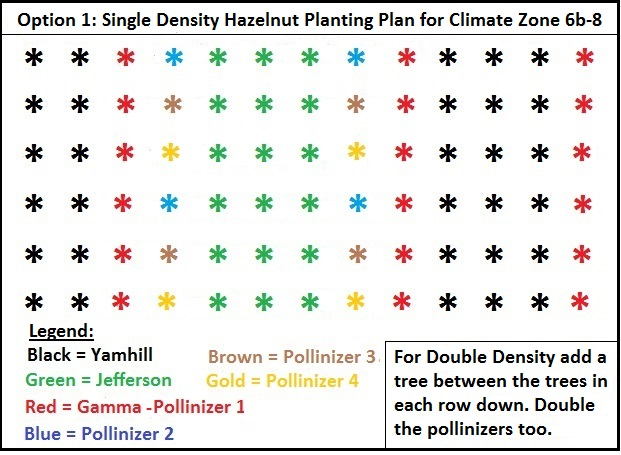
Option 2 is suggested as an alternative that leaves out 'Jefferson' in the planting. This will reduce the need for as many sprays for filbert blight, possibly eliminate them. 'Gamma' then becomes the second main crop cultivar as well as one of the pollinizers. Tree spacing is suggested at 18 x 18 feet (5.5 x 5.5 M) for the final spacing. Double density planting is considered as a way of getting double the product in the early years while the trees are small. This could be for 5-10 years depending on soil and growing conditions. Trees to be removed could be moved with a tractor tree spade to a new orchard site and be productive in a few short years. 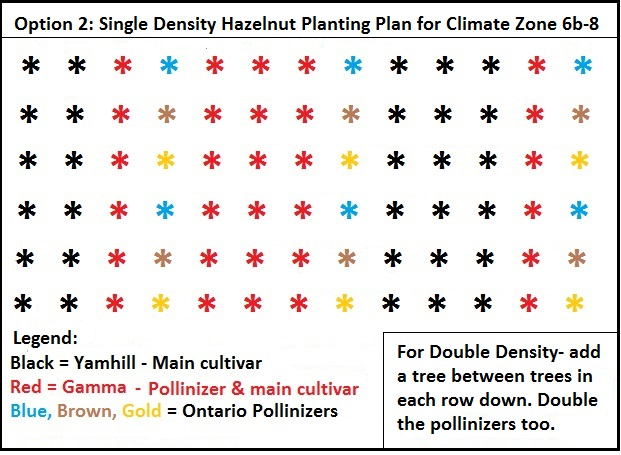
Pest Control Blue jays are a major pest in hazelnuts. They carry away the nuts as they ripen and flocks are capable of substantially reducing the crop. It takes two or more deterrents to keep them away. Bird Gard is an electronic device that mimics the distress call of various birds including the eastern blue jay as well as the attack call of a hawk. This alone is only moderately effective for a short time. Coupled with several Scare Eye balloons hanging 4 metres up around the orchard, the results are more remarkable. Further controls may be necessary as the ripening season progresses. Other pests can include squirrels, opossums, voles, mice and crows. These can be controlled with traps, and other devices. Other References SONG strongly recommends membership in the Ontario Hazelnut Association for the serious hazelnut grower. To get further information on growing hazelnuts commercially, the following references are available from: * A fact sheet: produced by the Ontario Government: http://www.omafra.gov.on.ca/english/crops/facts/12-011.htm *The Grimo Nut Nursery website: at http://www.grimonut.com Click on the "Hazelnut Orchards" tab. * The Upper mid-west USA http://www.midwesthazelnuts.org/ * The Northern Nut Growers Association: http://www.nutgrowing.org/ * Oregon State University fact sheets: breeding by Dr. Shawn Mehlenbacher. http://extension.oregonstate.edu/yamhill/hazelnuts-filberts * Rutgers University: breeding by Dr. Thomas Molnar http://agproducts.rutgers.edu/hazelnuts/ * The Hybrid Hazelnut Consortium: breeding by Dr. Thomas Molnar https://www.arborday.org/programs/hazelnuts/consortium/ |
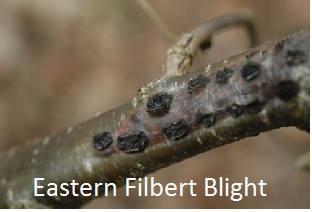 In Eastern North America, hazelnuts have not been commercially successful. This is largely due to a disease called eastern filbert blight, a fungus disease which invades the twigs and eventually kills the plant. The native hazels are resistant, some are even immune to this disease. The Turkish tree hazel is also resistant to eastern filbert blight. A number of breeders have crossed these species with the European hazel, resulting in selections that are hardier than the European and resistant to the blight. The trees are intermediate in size but have the European nut size.
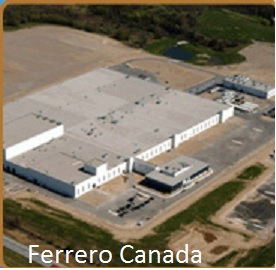 Ferrero Rocher Canada has spearheaded projects in Ontario through the Ontario Hazelnut Association to encourage commercial plantings of hazelnuts. They promise to buy all of the nuts we can produce that meet their quality requirements. This has promoted a great deal of interest in hazelnuts for Ontario and Eastern Canada.
All rights reserved.