



Establishing a Nut Orchard |
|
Climate, Site and SoilThe first priority in developing a successful nut orchard is to determine that the climate, site and soil are suitable for the crop you are trying to grow. The climate should be within the climatic zones suggested for the tree, preferably protected from late spring frosts. The site should be gently sloping, well-drained and without low spots or frost pockets. While hillsides may be attractive planting sites for timber trees, steep slopes are not easy to maintain for nut harvesting purposes. If tile drainage is necessary, make sure that an appropriate outlet is available to you. Plan where the trees will go and put in the tiles between the rows of permanent trees. This will prevent the tree roots from getting into the tiles and blocking the drains. Tile contractors can be a year behind in getting to your job, so planning ahead is essential. It also helps to order trees a year or more in advance for large plantings. The soil should be a loamy sand or clay. Check with you agricultural experiment station for information on your soil type and do a soil test to find out what nutrients are needed. The soil test will determine the pH of the soil. Most nut trees prefer a near neutral pH of 6.5-7.0. Chestnuts and pines prefer a lower pH of 5.5 to 6.0. To raise pH add agricultural lime and to lower the pH add agricultural sulphur. It is harder to lower the pH than to raise it so reconsider the crop for your site if it is not easily adjusted. Plough in your soil needs, particularly potassium before you plant, as this nutrient is very difficult to incorporate after the trees are planted. Plant a cover crop the year before, if possible, to add organic matter and to enrich the soil. Plough down the cover in the spring before planting and disk and harrow, pick rocks etc. in preparation for planting. A smooth surface is important for orchard management especially for harvesting. Planning Your OrchardDecide on the spacing of your trees and measure, then mark out the planting sites being sure that no rows are too close to field tiles. This can vary according to the species being planted and the overall planting goals. After cultivating the field and preparing the soil for planting, you will need to mark the tree spaces in advance. This is an important step in establishing the orchard. Planting helpers need to know your orchard plan in advance so they don't plant the wrong cultivar or mix up the cultivars in the rows. Establish how far in from the edge of the field the tree rows will be first, and then mark the four outside corners of the planting, allowing for tractor/harvester turning and other management activities, especially at the row ends. 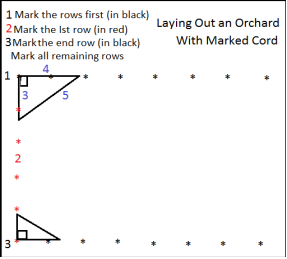
Planting the TreesAs soon as your nursery stock arrives, it is important to make sure the tree roots are kept moist by spraying with water and keeping them in a plastic bag to keep the wind off and to prevent drying. If they can't be planted right away, heel them in on the north side of a shelter or keep them covered with tarps and wet straw or peat moss in a frost proof but cool building. The roots must be protected from drying winds, bright sun and below freezing temperatures at all times while they are out of the ground. Transport the trees in large black plastic bags to the planting sites in a covered truck or wagon, making sure the roots are always protected. Centre the tree and be sure it is aligned with others in the row before backfilling the soil. Do not prune the tree roots or bend them around to fit the hole, instead dig the hole bigger to accommodate the tree as needed. Make sure that you spread the roots as you plant to provide the tree with plenty of soil contact. Check that the root collar is even with the soil surface or slightly below. Tamp the soil around the roots gently with your feet to remove large air pockets as you refill the hole. Water the tree liberally after planting. Put a mulch of wood chips around the tree about 5 cm (2 in.) thick and out about 2 m (6 ft.). This is very important for the first 3-5 years as it will keep weeds down and prevent them from hampering tree root development and growth. Orchard AftercareWeeds that find their way through the mulch can be pulled or sprayed with Roundup herbicide. Be careful not to contact any part of the tree. Check for insect damage, especially caterpillars, aphids or leafhoppers and spray accordingly. The trees are susceptible to insect damage beginning in June, particularly in the first year as they have been weakened by transplanting.
Soon after planting the trees, a ground cover may be established. Dwarf perennial ryegrass is ideal for this purpose as it is slow growing, less competitive with the trees and requires fewer mowings during the growing season. It is available through most farm supply outlets. After the first year, 15-15-15 fertilizer can be added annually in early May. Apply to the mulch and avoid contact with the tree trunk. A handful is all that is needed in the first year, but you may need to provide your ground cover with an annual application to help it fill in. Some corrective pruning may be necessary in the spring of the second year, but this should be confined to pinching back the undesired growth to favour the upward growth of the main trunk or stem. |
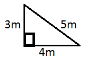 The most accurate way to lay out an orchard is with a surveyor's transit and compass or g.p.s. For do-it-your-selfers, the next best way is to prepare a cord or rope with markers (e.g. colored tape) each distance the rows will be apart. Mark a second rope with the tree spacing distance marked on to be used at right angles to the line of rows. Do not use nylon cord- it has too much "give." Binoculars would be useful to ensure straight lines.
 Repeat this as needed to complete the whole field.
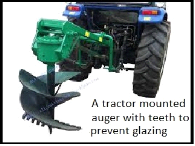
A day or two before planting dig your holes by hand or with a 20 inch auger. Do not dig the holes deeper than the deepest roots. This will prevent sink holes later, caused by the settling of the soil that takes the tree down with it. This is a particular problem when using an auger. Mark the sites with coloured ribbon. This will be a guide to make sure that the proper tree is in the site and that the planting plan is being followed. If your soil is lacking in organic matter, mix the planting soil with and equal volume of peat moss and a handful of potassium (0-20-0) or bone meal. Well-rotted compost may be used on the surface but not mixed fertilizers or manures as these can burn roots and cause harm.
Repeat this as needed to complete the whole field.
A day or two before planting dig your holes by hand or with a 20 inch auger. Do not dig the holes deeper than the deepest roots. This will prevent sink holes later, caused by the settling of the soil that takes the tree down with it. This is a particular problem when using an auger. Mark the sites with coloured ribbon. This will be a guide to make sure that the proper tree is in the site and that the planting plan is being followed. If your soil is lacking in organic matter, mix the planting soil with and equal volume of peat moss and a handful of potassium (0-20-0) or bone meal. Well-rotted compost may be used on the surface but not mixed fertilizers or manures as these can burn roots and cause harm.
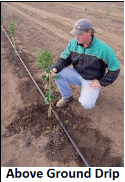 Water regularly through the first growing, or better yet set up an irrigation system to water the trees as needed. A surface drip system will do when the trees are small, followed by pop-up sprinklers as the trees grow larger or an underground drip water system. Irrigation is particularly important in the light sandy soils of the "tobacco belt" in Ontario.
All rights reserved.